Every project is bespoke
Format, hardware, interaction model and campaign logic differ per brand and per rollout. Off-the-shelf digital signage platforms assume a rectangle on a wall, not a sensor-triggered element built into a custom fixture.
Founded in 1966, DEINZER has spent nearly six decades building a reputation on three things: quality, design, and reliability. The company produces high-quality permanent displays and shopfitting solutions for brands that expect their presence at the point of sale to look exactly as intended, in every store, for years.
Over the past several years, that mandate has extended into digital. Screens, sensors, and interactive elements now sit inside the same displays DEINZER has always built. The physical craft hasn't changed. What's changed is that a display now also has to boot, update, and keep running unattended in a supermarket in another country.
That is a software problem, and it arrives with the same expectation as everything else DEINZER ships: it has to work.
Digital in-store media is deceptively hard. A screen in a showroom is straightforward. A retail network is a different discipline entirely:
Format, hardware, interaction model and campaign logic differ per brand and per rollout. Off-the-shelf digital signage platforms assume a rectangle on a wall, not a sensor-triggered element built into a custom fixture.
Unreliable store networks, no on-site IT, staff who will unplug something to charge a phone. A device has to recover on its own.
Brand teams and DEINZER's own project managers schedule and change content, not developers.
Manufacturing and installation dates don't move. Software has to be ready when the display ships.
GDPR-compliant handling of any sensor or interaction data, and the documentation standards DEINZER's clients expect.
DEINZER didn't need a vendor for a single project. They needed permanent engineering capacity that understood their business, available across parallel rollouts, without building an in-house software department alongside a manufacturing operation.
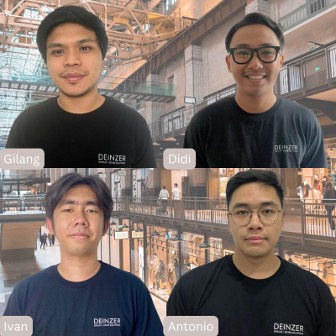
WOLKK provides a dedicated engineering team working directly with DEINZER's project and design leads. The team is embedded in DEINZER's processes: their project cadence, their timelines, their quality expectations. German-speaking project leadership sits between the engineers and DEINZER's teams and clients, so requirements are discussed once, in one language.
Interactive product finders, configurators, sampling and try-out stations, promotional mechanics, each built to the specific display and the specific brand brief. Interaction design follows the physical form, not the other way around.
From compact shelf-edge units to large-format installations, the same underlying platform scales across dimensions and hardware while each deployment keeps its own look and behaviour.
A single interface for DEINZER and its clients to manage campaigns, playlists and regional variations, designed for marketing teams, not administrators.
Interaction and playback analytics that give brands proof of performance at the shelf, with data handling designed to be GDPR-compliant from the outset.
The same engineers move across rollouts, so accumulated knowledge of DEINZER's hardware, clients and constraints stays in the team.
A shared platform carries the parts every project needs, content delivery, updates, the common infrastructure. Project-specific work goes into what's actually unique. That's what makes bespoke digital displays economically viable per rollout.
Software milestones are planned against manufacturing and installation dates, not sprint boundaries.
Our afternoon is DEINZER's morning. Overnight progress, daily handover.
Handover packages, architecture decisions and operating runbooks, the same standard DEINZER applies to its physical products.
The work has been recognised where it counts: DEINZER's digital in-store concepts have won multiple industry awards, including the POPAI / DACH Award. Awards in this category are judged on execution, whether the installation actually performs in the store, not whether it looked good in a pitch.
The engagement continues as an ongoing partnership, with the WOLKK team supporting new rollouts as DEINZER's digital portfolio expands.
DEINZER's advantage is nearly sixty years of knowing how a display should be made and how retail actually works. That doesn't transfer to a software vendor, and it shouldn't have to.
Our job is to supply the engineering, permanently available, familiar with the domain, working to the standard DEINZER's name carries, so that the digital part of the display is as dependable as the physical one.
Building physical products that are becoming digital? That transition needs an engineering team, not a project. Let's talk about what yours would look like.